Signal / Noise Theory
A while back I remarked on Twitter that we needed to embrace Critical Theory into our theory and practice of communications. The stimulus to this was a remark about Signal to Noise Ratio (SNR) theory. Lee Bryant picked me up on this and I expanded a little more on the topic on Twitter.
Firstly, what do I mean by Critical Theory? The term originated in the pre-war Frankfurt School, specifically in Max Horkheimer’s Traditional and Critical Theory (1937), and has evolved in to an uneasy tension between its original radical ethos and a motley school of cultural theory, sometimes just abbreviated to Theory. It was the latter I uncounted at the University of Nottingham in the early 1990s when I took their MA in Critical Theory.
The MA was tremendously educative and covered a wide array of theoretical schools ranging from the ‘Hermeneutics of Suspicion’ – Freud, Marx and Saussure, through to contemporary Feminist and American critiques and Postmodern / Poststructuralist thinkers. All of which were viewed as complete heresy by the traditional philosophy department.
Now if there was a common thread in all that we looked at, it was a shared distrust of any sense of a ‘natural essence’ or primordial authentic base on which to build from. Indeed it was almost taken for granted that theories of Signal Noise Ratio (SNR) had no real place in these philosophies – at least to the extent that some primers had a section on SNR as a means of counterpoising how communications theory had moved on from its reductive past. It was also a concept that 1st year arts students would be taught was too simplistic and reductive to have merit in what they were about to study (at that point the pain would be almost audible as they were introduced to Roland Barthes and many wished they’d signed up to study computing or some other clearly more useful area).
So what’s so wrong with Signal Noise Ratio then?
It’s a theory originally developed in the study of radio: where “signal-to-noise ratio is defined as the power ratio between a signal (meaningful information) and the background noise‘:
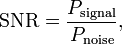
Which seems very plausible for internal comms or marketing comms theory until we point out that:
- It becomes a metaphor when moved from radio signal science to social comms theory (and yes there’s buckets of leaky metaphors here too and I could do with lots of “”).
- Human comms are not radio signals, society or other people or voices are not noise
- The signal is never pure meaning that is corrupted by surrounding noise – who, where, what defines the signal as having meaning and the noise as pollution corrupting that noise? Think of this in the 2.0 world (and many do so thus) and the broadcast message becomes the signal and the socialness surrounding it is what, noise?
- It implies a purity of meaning divorced from any social setting – power, discourse, ideology, narratives, that somehow becomes noised up by signals that shouldn’t be there – who says so?
- Signal theory embraces a unity of signifier and signified that Semiotics blew out the water almost a century ago
- What if there are two competing signals (of course this never happens in the corporation0 who says which is signal and which is noise?
- If noise can become signal and vice versa by decree, or a redefinition of usefulness (as often happens with for example mashups or mixes), where is the primal meaning of the signal
And there is more, but I’ll finish at this point as I think I’ve made my point…and without Derrida either 😉
See also Stowe Boyd & David Armano on this area The Human Feed: How Humans Filter Signal From Noise and The False Question Of Attention Economics, though David makes a slightly different use of the metaphor, I’m with Stowe on this one…
Interested to hear what others think on this – I may need to dig out some old notes here…
One reply on “Towards deconstructing the Signal / Noise Theory”
Hi Russel,
interesting thoughts on SNR. I agree with your points.
SNR theory is last millenium marketing stuff, made before the social web took place. For me these theories are the last attempt to create a feeling of control about something that can’t be controlled. Especially in marketing termns.
I believe marketers won’t see that all these opportunities of the social web have a price: Advertizing, Brands, Products, etc take place within the social web while before they have been positioned above humans.
Measure of SNR is only needed for the “external view” of classic marketing. Within the community it’s pretty easy to discover how your brands or product signal are recieved by others.
Sorry for David, Seth and all the others.